Description
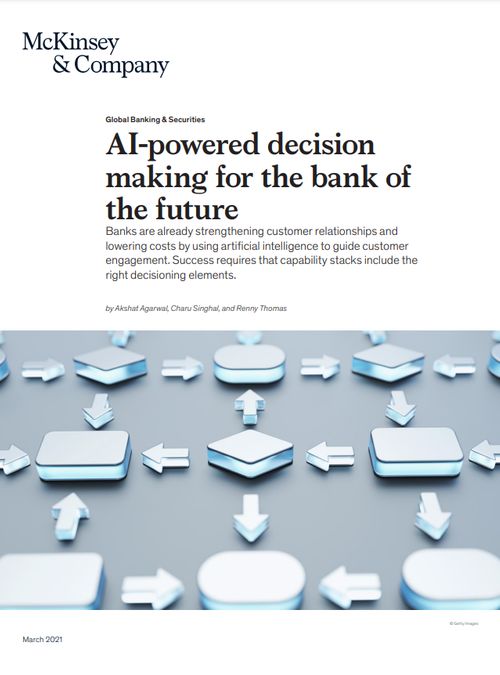
The ongoing shift to digital channels gives banks the opportunity to serve more customers, expand market share, and increase revenue at lower costs. Importantly, banks that seize this opportunity can also gain access to larger and richer data sets needed to support decision-making mechanisms using advanced analytics (AA) and machine learning (ML). When deployed at scale, these AI-based decision-making capabilities can provide banks with a decisive competitive advantage, creating significant additional value for customers, partners, and the bank itself.
Banks aiming to compete in global and regional markets, markets increasingly influenced by digital ecosystems, will need a comprehensive set of AI and analytics capabilities, including four key layers:
- Reimagined customer engagement
- AI-based decision-making
- Core technology and data infrastructure
- Advanced operating model
Benefits of AI for Banks
AI capability sets in banks are interdependent and must work in sync to deliver value. The focus is on the core AA/ML decision-making capabilities needed to understand and respond to changing customer needs accurately, quickly, and efficiently. Banks that use machine learning models to determine in (near) real-time the best way to engage with each customer can create value in four ways:
- Enhanced customer acquisition
Banks gain an edge by creating superior customer experiences through end-to-end automation and using advanced analytics to craft personalized messages at every stage of the acquisition process. - Greater customer value
Banks can increase customer value by consistently and intelligently engaging with them to strengthen relationships across various products and services. - Reduced operational costs
Banks can cut costs by maximizing automation in document processing, analysis, and decision-making, especially in acquisition and servicing. - Lower credit risk
To reduce credit risk, banks can apply more sophisticated scoring of potential clients and early detection of behaviors that signal a higher risk of default or fraud.
Building a Flexible AI Decision-Making Engine
Banks are seeking to develop and build a flexible, fully automated decision-making engine within their AI capability set. They can benefit by focusing efforts on four interdependent elements:
- Using AA/ML models for automated, personalized decisions throughout the customer lifecycle
- Building and deploying AA/ML models at scale
- Enhancing AA/ML models with what is called “advanced” capabilities to reduce costs, optimize the customer interaction cycle, and improve overall service quality
- Creating a unified digital marketing engine to transform insights from decision-making into coordinated messages delivered during customer interactions
The rapid advancement of AI-based technologies is driving competition in speed, cost, experience, and intelligent offerings. To remain competitive, banks must engage customers with highly personalized and timely content. Personalized offers with tailored communication—delivered at the right time through the customer’s preferred channel—can help banks maximize the lifetime value of each relationship and strengthen their market leadership.
To achieve these benefits, banks must build AI-based decision-making capabilities grounded in a rich mix of internal and external data, enhanced by advanced technologies.