Description
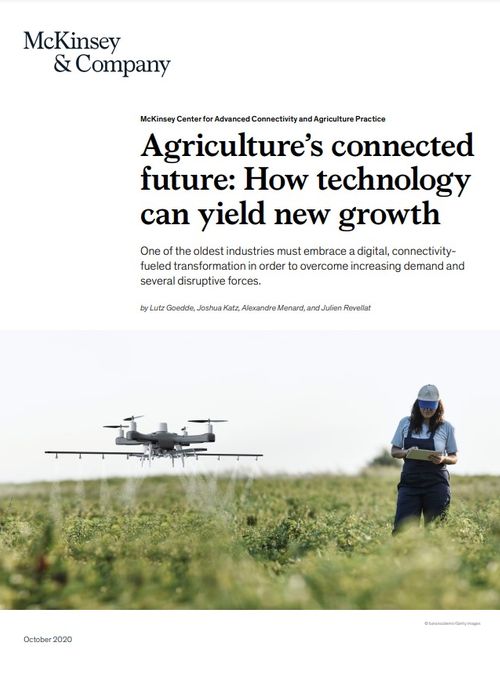
In the McKinsey & Company report “Agriculture’s connected future: How technology can yield new growth,” which focuses on digital technologies, it is noted that the technologies currently used in agriculture are generally designed for mechanical and genetic purposes.
“Much more sophisticated digital tools are now needed to leap in productivity,” the report emphasizes.
“Agriculture is on the brink of another revolution—one driven by data and connectivity. Artificial intelligence (AI), analytics, monitoring tools, and other cutting-edge technologies can further boost yields, improve water and resource efficiency, and enhance sustainability in both crop and livestock production.”
The Future of Connectivity
Over the next decade, existing technologies such as fiber optics, low-power wide-area networks (LPWAN), Wi-Fi 6, low- and mid-band 5G, and short-range connections like RFID will expand in capability and reach as supporting networks are developed.
“If internet connectivity is successfully implemented in agriculture, our research suggests the industry could add $500 billion to global GDP by 2030. This would represent a 7–9% improvement over expected outcomes and significantly ease the current burden on farmers,” McKinsey notes.
McKinsey & Company forecasts that by 2030, advanced connectivity infrastructure will cover about 80% of the world’s rural areas (with Africa being a notable exception).
As connectivity becomes more widespread, these tools will unlock new opportunities in agriculture and pave the way for digital transformation:
Key Enablers of Digital Agriculture
- Massive Internet of Things (IoT):
Low-power networks and cheaper sensors will lay the foundation for expanded IoT use, enabling precision irrigation, large-scale livestock monitoring, remote building diagnostics, and fleet management. - Critical Services:
Ultra-low latency and improved connection stability will support applications requiring high reliability and responsiveness, such as autonomous machinery and drones. - Near-Global Coverage:
If low-Earth orbit (LEO) satellites reach their potential, even the most remote agricultural areas could access digital technologies, boosting global productivity.
“Initially, the greatest value will come from large farms, which have more resources to invest and stronger incentives to digitize,” the report states.
“Connectivity enables easier monitoring of large areas, and the fixed costs of IoT solutions are easier to absorb at scale. Crop farming, in particular, stands to benefit more than the meat and dairy sectors due to larger average farm sizes, greater consolidation, and better adoption of connected technologies suited for static monitoring.”
Five Use Cases for Connectivity in Agriculture
- Crop Monitoring:
Connectivity enables better crop observation and care. Integrating weather, irrigation, nutrient, and other data systems can improve resource use and yield through more accurate detection and forecasting of deficiencies. Smart monitoring also helps optimize harvest timing to maximize income. - Livestock Monitoring:
Preventing disease outbreaks and identifying distressed animals is critical in large-scale livestock operations. Most animals are raised indoors, allowing for automated handling. Wearable chips and sensors measuring temperature, pulse, and blood pressure can detect illness early, preventing the spread and improving food quality. - Building and Equipment Management:
Chips and sensors can monitor silos and storage levels, triggering automatic reordering and reducing inventory costs. Many farmers already use systems from companies like Blue Level Technologies. - Drones in Agriculture:
The next generation of drones is transforming agriculture by enabling fast, efficient surveying of crops and herds over large areas. Drones can use computer vision to analyze field conditions and perform targeted actions like fertilization or pesticide application. They can also plant seeds in remote areas, reducing equipment and labor costs. This could generate $85–115 billion in value through cost savings and yield improvements. - Autonomous Agricultural Machinery:
Enhanced GPS accuracy, combined with computer vision and sensors, is accelerating the deployment of smart, autonomous farming equipment. Farmers can operate multiple machines simultaneously without human intervention, freeing up time and resources.
“However, much of this remains impossible until rural areas gain access to high-speed broadband. We see three main pathways for the necessary investments to become reality:
- Telecom-led deployment:
Telecom companies can benefit from the rising rural demand for connectivity. - Provider-driven deployment:
Input providers can partner with telecoms or LPWAN operators to build rural networks. - Farmer-led deployment:
Farm owners, either independently or in collaboration with LPWAN groups or telecoms, can also invest and retain control over their data.”
“The success and sustainability of one of the world’s oldest industries may well depend on this technological transformation – and those who embrace it early will be best positioned to thrive in the future,” the report concludes.