Description
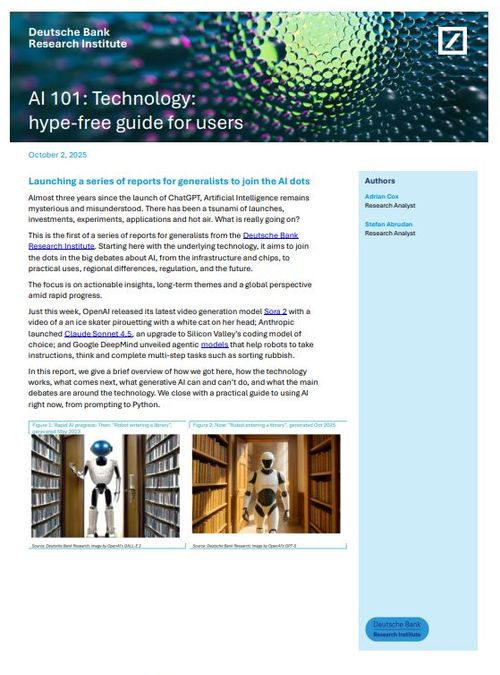
This is the first of a series of reports for generalists from the Deutsche Bank Research Institute. Starting here with the underlying technology, it aims to join the dots in the big debates about AI, from the infrastructure and chips to practical uses, regional differences, regulation, and the future.
The focus is on actionable insights, long-term themes, and a global perspective amid rapid progress.
Just this week, OpenAI released its latest video generation model Sora 2 with a video of a an ice skater pirouetting with a white cat on her head; Anthropic launched Claude Sonnet 4.5, an upgrade to Silicon Valley’s coding model of choice; and Google DeepMind unveiled agentic models that help robots to take instructions, think and complete multi-step tasks such as sorting rubbish.
In this report, we give a brief overview of how we got here, how the technology works, what comes next, what generative AI can and can’t do, and what the main debates are around the technology. We close with a practical guide to using AI right now, from prompting to Python.
Key takeaways for generalists
- The technology is getting better every day: sometimes it leaps and sometimes it shuffles, but it is only improving.
- It is a different kind of intelligence: despite appearances, it is not human, so should not be viewed and used as if it were.
- It’s all about the system: every new technology only reveals its true uses over time as systems emerge to use it.
What’s different this time?
The spark that lit the AI boom was the launch of ChatGPT by OpenAI, a little-known San Francisco-based startup, on November 30, 2022. The chatbot spread like wildfire, reaching one million users in five days and 100 million in two months, easily the fastest dissemination of any technology in history. It is now fast approaching 6 billion visits a month.